Welcome to SWLog
Logging since 1988
Shortwave & Amateur Radio Log (SWLog) is a suite of applications that provide logging and remote control for amateur radio plus shortwave, utility, and broadcast listening. SWLog has been continuously improved and expanded since it was first released 36 years ago.
Unified Suite
SWLog is a suite of products that provides logging, radio control, GPS synchronization, QSL management, reporting, and propagation prediction. Program schedules from HFCC, ILGRadio, AOKI, ADDX, SWSkeds, EiBi, and others are leveraged for broadcast reception. Call sign lookups and remote logbooks are integrated with ClubLog, eQSL, QRZ, Ham365, HamQTH, and LoTW.
Android & iOS Apps
SWLog provides Android and iOS applications for logging on the go as well as web servers for logging and remote control from anywhere. The apps seamlessly transfer logs without the tedium of ADIF export/copy/import.
Web-based Logging & Radio Control
In addition to a traditional desktop application, SWLog has a web-based application that allows for adding shortwave/broadcast/utility and amateur radio logs. Recent logs (QSOs) can be viewed. The web application also allows for remote control of radios. This runs under Linux or Windows.

Click on each tab below for detailed information about the topic.
News
YouTube demos from Orlando Hamcation
Tim Davis, GraymanPOTA, has posted a video featuring SWLog on YouTube. Please also subscribe to Tim's channel.
Steve, KO4ALF Ham Radio, has posted his interview from Orlando Hamcation. Please check it out at YouTube. Please also subscribe to Steve's channel.
New License Class for Broadcast Logging
A new license for logging only shortwave, mediumwave, longwave, utility, FM, and other broadcast logs is available. All of the amateur radio features are squelched.
Download
SWLog runs on Windows and has a specific, tailored features that run on Linux, Android, or iOS. Advanced users can configure the database to run in a Docker container or on native Linux. A web front-end can run on a Raspberry Pi or Ubuntu. Android and iOS have apps that are available from the respective stores for mobile logging.
Build 8857 - Released April 1, 2024
SWLog is released on a rolling schedule. When sufficient new features are coded or bugs are fixed, a new release will be posted. To view the changes for a release, click here.
windows-amd64
All desktop (i.e. non-mobile) applications within the SWLog suite run on Windows. This is for full installations and upgrades.
Targeted for AMD- and Intel-based systems running Windows 11 or Windows 10. The installation package will optionally download and install SQL Server Express 2022. Compatible with SQL Server 2017 or 2019.
linux-arm
Supports a subset of features, namely the Radio Control and Web Control servers. Does not support the main logging program.
Targeted for the Raspberry Pi 3B+, Pi 4, Pi 400, Pi 5, or Pi Zero 2 W. It has not been tested on other platforms.
linux-amd64
Supports a subset of features, namely the Radio Control and Web Control servers. Does not support the main logging program.
Targeted for .NET supported Linux distributions, although it has only been tested on Ubuntu.
Android
A mobile logging application for shortwave/broadcast and amateur logs.
Targeted for Android 13 and higher. Designed for the Samsung Galaxy, Google Pixel, and other Android phones that have the current version of Android. Downloadable from the Google Play store.
Android (Sideload APK)
A mobile logging application for shortwave/broadcast and amateur logs.
Targeted for Android 11 (API 30) and higher. Provided for Android devices that are older and cannot download the app from the Google Play Store. Contains an APK for sideloading. Note that this might not work with all devices.
Apple iOS
A mobile logging application for shortwave/broadacst and amateur logs.
Targeted for iOS 16.4 and higher. Designed for the iPhone.
Licensing
When originally released in the fall of 1988, SWLog was released as shareware. In keeping with that spirit, SWLog is available as a trial version and with one or two year licenses. All licenses are standalone and do not auto-renew. When a trial ends or when a license expires, the ability to export logs is unrestricted. The logs are never locked or paywalled.
While priced in US Dollars, the payment processor (Stripe) will dynamically convert to other currencies.
Trial Version
$0
- Valid for 60 days
- Radio Control sessions run for 30 minutes
One Year Plan
Broadcast & Utility Only
$19 / year
- This version only contains features for broadcast & utility logging.
- There are no functions for amateur radio.
- This is standalone; getting amateur radio functions will require a new license.
License Key Retrieval
If a license key has already been purchased, a copy can be retrieved here. Use the email address that was used when purchasing the license.
Frequently Asked Questions
SWLog started back in 1988 and was solely focused on shortwave logs. In the late 1980s, shortwave transmissions were the primary source of news and features from an overseas perspective. The big names in broadcasting such as the BBC, Radio Netherlands, Deutsche Welle, Radio Moscow, Radio RSA, Radio Australia, HCJB, Swiss Radio International, and many more broadcast daily to North America.
In 1988 SWLog was (obviously) a program written for MS-DOS. For the classic computer aficionados, SWLog version 1.00 was coded under MS-DOS 3.30 on a Tandy 1000 SX first with Borland Turbo C then with Microsoft C 6.0A. The logs were stored with the Paradox database engine. While the original version does still technically run, the code to import the data from Paradox has long been sunsetted. So any logs would be effectively orphaned. For retro-PC enthusiasts, version 1.21 of the MS-DOS program can be downloaded. It can be run under DOSBox and DOSBox-X, so a traditional MS-DOS virtual machine is not strictly necessary.
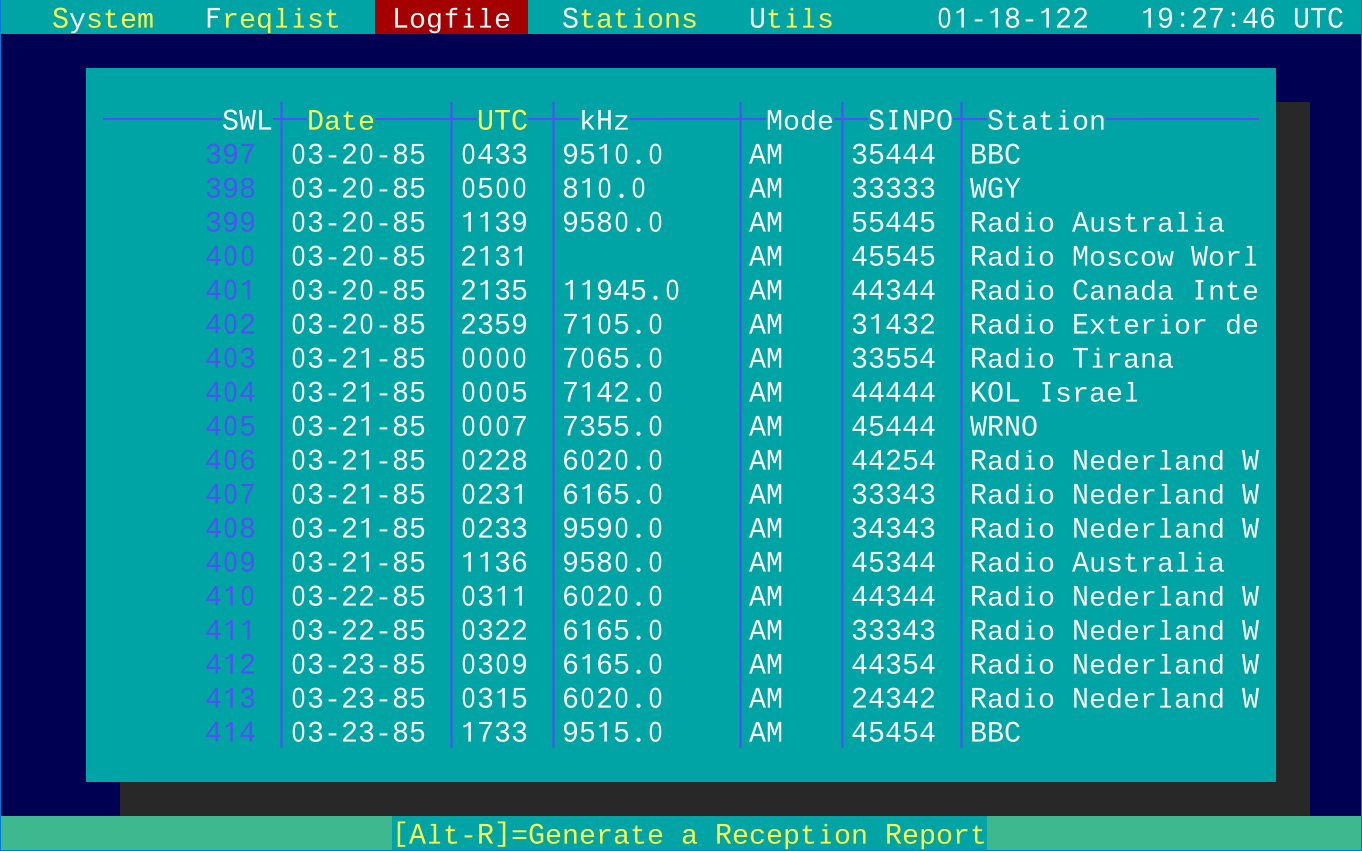
SWLog was originally distributed on BBS systems and the well-known Simtel MS-DOS Archive, which was the primary method of distribution as CD-ROMs of the Simtel archive were widely available at computer fairs in the early 1990s. By 2004 the web site was created and SWLog started to be distributed as a download, although users could still obtain a CD-ROM version if necessary.
As the years progressed, the scope and features expanded and the underlying technology has changed. A dedicated section for logging amateur radio QSOs was added in the early 2000s. SWLog is today a suite of programs providing not only logging but radio control and extensive reporting.
At first blush, it is obvious that SWLog just looks and operates differently from other logging programs that look and act like Excel for Windows 95. SWLog eschews the 1990s aestetic that is so typical of radio-related programs.
Secondly, SWLog is built upon modern technologies. While SWLog has been in development since 1988, it has continually stayed modern and has thus avoided becoming legacy software that is so aged that it must be discarded and rewritten. SWLog is designed to be flexible from a single notebook comptuer to a home lab setup to cloud-based.
And do not forget the maps! SWLog is admittedly a bit map crazy!
The data that is collected and how it is collected simply differs beetween broadcast and amateur logs. For example, a shortwave or AM/FM log would use frequency databases like ILGRadio, HFCC, or FCC AM/FM Engineering. Amateur radio logs use data from QRZ, the FCC, HamQTH, ClubLog, etc. However, the underlying structure for both types of logs is unified in the database.
Or think of it as like the McDonald's McDLT - the hot stays hot and the cold stays cool!
Bundled with the installer is a PDF that can be printed old-school style like the old Word Perfect manuals from the 1980s! Based upon feedback, the once beefy documentation has been reduced and streamlined to contain just the essentials.
After the one- or two-year license expires, the program will continue to function with reduced functionality.
SWLog is proudly coded entirely in America in the State of Florida. No offshore assets are used whatsoever. It is critical to sustain a high-tech, local workforce and to not offshore for profit.


Support can be found on the groups.io forum. Priority is given to licensed users.